Posts

MLK Weekend Remarks at Zion Baptist Church: "Be the Light" | by Andrea Kahn-Kothmann

Image
I must share today that, despite the joy we all feel this morning, I’m often burdened with the sense that we just haven’t made enough progress in the more than 50 years since Reverend King left this world.  Legal segregation has largely been eliminated, voting rights are clearly established in our statutes and diversity has been recognized as fundamental to good business and progressive education, but discrimination and racial prejudice in many forms still persists in our society. In a world where there’s still so much to be done to achieve Reverend King’s dream, it’s easy to feel overwhelmed and pessimistic. First, our political climate is one of the most divisive in recent memory.  How can we make progress toward unity and understanding when we so often talk past one another from the comfort of our echo chambers?   Second, our country is led by a uniquely and sometimes startlingly coarse executive who regularly gives voice to racial and ethnic bigotry.   ...
A Year of Civil Conversations Religious Leader Reflections: “The Vitality of Ordinary Things" | by Rev. Jesse Garner

Image
In a program first broadcast on April 12, 2018, Krista Tippett interviewed Michael Longley, a poet from Northern Ireland.  Although recorded live in 2016—in Belfast—the program was not aired until two years later to coincide with the 20th anniversary of the Good Friday Agreement which had brought to an end the worst of the sectarian violence that had plagued that land for so many years. The “Troubles” were the backdrop for much of Longley’s poetry, as they were for other Irish poets of the time, among them Nobel Laureate Seamus Heaney, but they were rarely the subject of his poetry, at least not directly.  No, the subject of his poetry was—in Tippett’s memorable phrase—“the vitality of ordinary things precisely in the face of what is hard and broken in life and society.” Longley’s celebration of the “vitality of ordinary things” was (and is) his way of celebrating what is most human about us.  Those things that we are tempted to call the “little things” of “ordina...

A Year of Civil Conversations Religious Leader Reflections: "Words Make Worlds" | by Rabbi Jill Maderer

Image
Photo by Alexandra on Unsplash Krista Tippett is constantly expanding my mind and soul to new meaning about theology and about humanity.  In her book, Becoming Wise: An Inquiry into the Mystery of Art of Living , here is what Tippett says in her second chapter called "Words: The Poetry of Creatures:" "The words we use shape how we understand ourselves, how we interpret the world, how we treat others.  From Genesis to the aboriginal songlines of Australia, human beings have forever perceived that naming brings the essence of things into being.  The ancient rabbis understood books, texts, the very letters of certain words as living, breathing entities.  Words make worlds.  We chose too small of a word in the decade of my birth -- tolerance -- to make the world we want to live in now.  We opened to the racial difference that had been there all along, separate but equal, and to a new infusion of religions, ethnicities, and values.  But tolerance ...

Cultivating Curiosity in 2019 | by Max Dugan

Image
At the beginning of each Gregorian New Year I take the annual (re)birth as an opportunity to reflect on connections, habits, and feelings of the previous 365 days. Pondering the meaning and pull of interfaith work sits at the core of this meditation. Why do we continue to engage in this often challenging, discomforting, and humbling activity? Couldn’t my time be better spent elsewhere? Does anything we do really make a positive difference? The answer bubbling to the surface in nascent 2019: the foundation of my interfaith work is curiosity . This just resonates. In general, there is something inherently harmful in social complacency. In this particular socio-political context, the value of empathy and active engagement with the other is more apparent than ever. And in my personal experience, satisfaction with one’s current awareness reduces the sacred joy that comes with connecting and learning about whoever sits across from you. The anecdote that most perfectly exemplifies this...

Jewish Journey, World Expanding | by Natalie Katz

Image
I grew up as a secular Jew in a sheltered corner of Suffolk County, Long Island where everyone I knew was either Jewish or Catholic, and almost everyone was white.  Unlike most Jewish families on Long Island, my family did not belong to a synagogue.  My parents were secular – Jewish by culture and identity, but not religious.  We attended a Jewish cultural school on Saturdays, where we studied Yiddish, music, bible studies, and current events.  Our education explored the rich history and traditions of our ancestors. One of my teachers, Ruth Minsky Sender, was a Holocaust survivor from Lodz, Poland.  As a young teenager, she survived imprisonment in Auschwitz because her poetry uplifted the spirits of the other women in her barracks.  In her soft Polish accent, she explained to us the horrific circumstances, sharing her experiences in the ghetto and the concentration camp, and delicately answering our questions.  This was not the cold facts of a...

Neither this nor that: "How Walking the Walk helped me escape my double life and embrace my true identity" | by Arisha Syed

Image
I grew up in a moderate, Muslim-American family—first generation American on my dad’s side, second generation on my mom’s. Both of my parents hoped that raising their three daughters in the U.S. would bring us a comfortable life, and, by the grace of God, we have a roof over our heads, food on the table, money for college, and we even go on the occasional vacation. However, September 11, 2001 drastically changed my family’s sense of comfort in the U.S. and altered the way we looked at the world. After 9/11, my family wasn’t comfortable identifying openly as Muslim and operated by one simple rule: culture is for the world, religion is for the home. Even though I felt like an outcast as one of the only brown kids in school, I was encouraged by my parents to embrace my Indian/Pakistani heritage. However, I was also told to always conceal my religious beliefs from the public. It never made sense to me, even as early as a 6-year-old. Why could Christian kids freely celebrate ...

"Why Travel to Come Home Again?" Reflections on an Interfaith Experience in the Middle East

Image
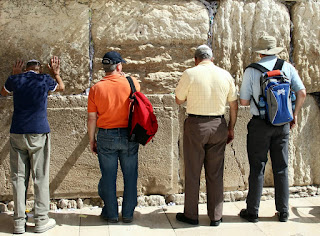
Why travel to come home again? As the Interfaith Center entered its second decade, the idea of an interfaith journey to the Middle East found its way back to our leadership table.  Put aside in prior years, this idea seemed to come of age along with us.  What did we need to experience from afar that would help us come back home and better serve the Greater Philadelphia region? So 19 of us – Christian, Muslim and Jewish Philadelphians, including four Board members and myself – ventured on our first  Dare to Understand  trip to the Middle East this October. Our extraordinary guide, Julian Resnick, an educator born in South Africa who has made his home in Israel, introduced and led our trip with this intention: “Most of the important questions, conversations and dilemmas can be considered wherever we find ourselves in this world. We can talk about freedom in our living rooms, but talking about freedom in Birmingham, Alabama adds something. We can ...